
Zheng Mahler: The Multiplicity of Worlds
2026-05-26
Kate Gu and Dorothea Lam
Since 2021, the artist duo Zheng Mahler—formed by anthrozoologist Daisy Bisenieks and artist Royce Ng—has explored the subjective worlds of non-human species on Lantau Island, Hong Kong. This research direction eventually developed into the Lantau Trilogy. Through technologies including 3D scanning and printing, virtual reality, and AI, the trilogy provides immersive or sensory experiences that open up microcosms of bats, water buffaloes, and mushrooms. Two works from the trilogy are on view at AAGFF 2026: What is it like to be a (Virtual) Bat? is displayed on the video wall at the East Entrance and as a VR experience at the Festival Lounge, while the M+ web digital commission, The Twenty-Three Thousand Sexes of Schizophyllum Commune and Other Stories (2026), is presented through a screening and talk.
Below is an excerpt from an artist interview on the web digital commission with Zheng Mahler, conducted by curator Kate Gu. Click here to read the full interview.
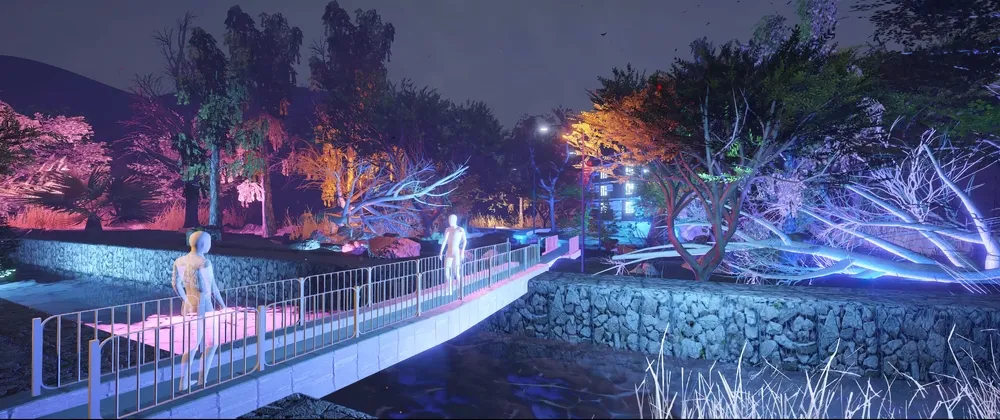
Zheng Mahler. Still from What is it like to be a (Virtual) Bat? Phase IV – Bat Meditation, 2022–2023. © Zheng Mahler. Image courtesy of the artists and PHD Group, Hong Kong
Gu: You started the Lantau Trilogy in 2021, having lived on the island since 2013. Could you speak about your journey with Lantau Island and explain why you chose to study the water buffaloes, the bats, and the mushrooms—perhaps as subjects through which to think about the island?
Bisenieks: We moved to Lantau when we began to do research for A Season in Shell (2013–2016) in Hong Kong. We wanted to live a quieter life again among mountains and trees, and being close to the sea was a bonus. We knew from previous trips to Hong Kong that the islands would be our preference if we were to live here. Royce was also familiar with Lantau Island through family visits as a child, and he still has family friends living here. Simultaneously, I was drawn to the unique coexistence of villagers and free-roaming water buffaloes and cows—a characteristic of Lantau Island—and thought it would be an ideal and interesting case study for my master’s research, which I began in 2013.
Living in such close proximity with creatures larger than ourselves and sharing an urbanising, residential space on a daily basis was incredibly interesting and obviously novel in a post-domestic place like Hong Kong. Conducting this research also became a way for us to learn about our new home, its everyday life and history, and how human and non-human relations have helped co-create the island’s communities, geography, and continuing narratives around issues of conflict and coexistence. These daily (or, in the case of fungi and bats, seasonal) interactions with our more-than-human neighbours are part of our life, whether it was gently navigating a buffalo or cow herd along a narrow village path on a bicycle, or anticipating clusters of fungi during the warm, humid months. Over the years, we became familiar with the seasonal feeding and courtship behaviours of microbats we’d observe outside our kitchen window at dusk as we prepared dinner. This became a little more obsessive during COVID-19 lockdowns; we were always looking forward to their daily acrobatic performances, and were naturally more curious given the reputation of bats in the time of COVID-19.
Gu: What draws you to the non-human world as a site of inquiry, especially in recent years? In A Season in Shell, you investigated abalone and shells as part of the global trade system, where they appeared to be passive objects circulating within human economies. In the Lantau Trilogy, however, you engage more directly with the question of subjectivity, inviting viewers to imagine and embody the worlds of non-human species.
Bisenieks: The life of abalone is central to A Season in Shell, as the title suggests. The ten-part poem accompanying the installation interlaces multiple narratives with experiential symmetries, including the life cycle of the red sea abalone and how it is ‘revalued’ as it gets absorbed into the value-adding chains of human economies and society. It was important to integrate a seemingly passive mollusc into the poetry of these relations. In the long life of an abalone, which helps filter our oceans, it may only move thirty centimetres if left undisturbed, but it can be carried thousands of miles once captured for trade. The shucked shells in the exhibition space unexpectedly invited curious visitors to touch and connect with the afterlife of the abalone. Through the texture and the odour of decay, a shell is a visceral reminder of an abalone’s life and death as well as the lives of many—including fishermen and handlers—who facilitated its travel. The sensory reality of trade is often minimised or removed entirely so that we often just see the product. Here, the abalone reveals the spectrum of experiences that colour economic life and its multiple passages, including its value as a museum object within the exhibition. It acknowledges the life sources that often fuel the livelihoods and systems we inhabit.
We’ve always been drawn to more-than-human worlds for their radical alterities, but we’ve focused on them even more in recent years, largely due to the pandemic and staying at home more on the island. We were invited to participate in an exhibition where I had the chance to share my research on the water buffaloes of Lantau Island, and this research evolved into an artistic exploration of their sensory perceptions of the world. Our attention to more-than-human sensory experiences expanded to include bats when we observed them around our house over the years and during the pandemic lockdowns. Their presence invited further contemplation on human–wildlife proximities and how another species might negotiate space with their sensory perceptions. At the time, Royce was also investigating ideas around embodiment for his PhD research on meditation and technology, which brought us to common ground with Thomas Nagel’s essay, ‘What Is It Like to Be a Bat?’ (1974).
My upbringing in a tiny town in Australia has also made me highly aware of sharing space with more-than-human beings and how they move through the world. Growing up, I was surrounded by a dense forest of towering, eighty-metre-tall mountain ash trees, which were immediately humbling, and my family would always observe the comings and goings of wildlife. My parents also instilled in me a sense of curiosity and a compassionate outlook towards the living world. In particular, my Latvian mother and her family’s animist traditions and cultural reverence for the natural world helped shape my sensibilities. This ecocentric perspective later made me wonder, as I neared the end of my anthropology studies, whether anthrozoological perspectives could provide more valuable insights into the complexities of human experience, interrogate the idea of human exceptionalism, and explore the dynamics of multispecies entanglements, including our shared vulnerabilities.
Kate Gu is Associate Curator, Digital Special Projects at M+ and Dorothea Lam is Assistant Curator, Visual Art at M+.