
On ‘Avant-Garde’: Student Editors’ Notes from the Sixth Floor
2026-07-30
Catherine Ip, Leah Li, and Myra Tse
The student editors for this year's Asian Avant-Garde Film Festival—Catherine, Leah, and Myra—arrived with an intuitive understanding of the title: ‘Asian’ marks a geographical framework, ‘film’ names the medium, and ‘avant-garde’ suggests experimentation and the vanguard. Yet once immersed in the Festival, they found that the term ‘avant-garde’ is even more difficult to grasp than the films themselves. Their initial definitions no longer seemed sufficient to encompass the breadth of the works on view, which prompted the following conversation in the editorial room on the sixth floor of the M+ building.
Catherine: What struck me was that many of the invited artists this year reflected, in one way or another, on how they had come to be defined as avant-garde and on what an avant-garde work is expected to be. During the round-table discussion with Jieun Cho, Larissa Sansour, Rirkrit Tiravanija, and Xu Bing, Tiravanija described the avant-garde as a form of nostalgia. Meanwhile, in Roger Garcia’s ‘Notes for Films’ talk, he explained that ‘avant-garde cinema has never had an immediate impact on commercial filmmaking, but instead exerts its influence gradually, through a sustained process of looking back.’ It is intriguing to consider why the curators have defined these artists and their moving image practices as avant-garde. As a student editor, I found myself equally puzzled by the term.
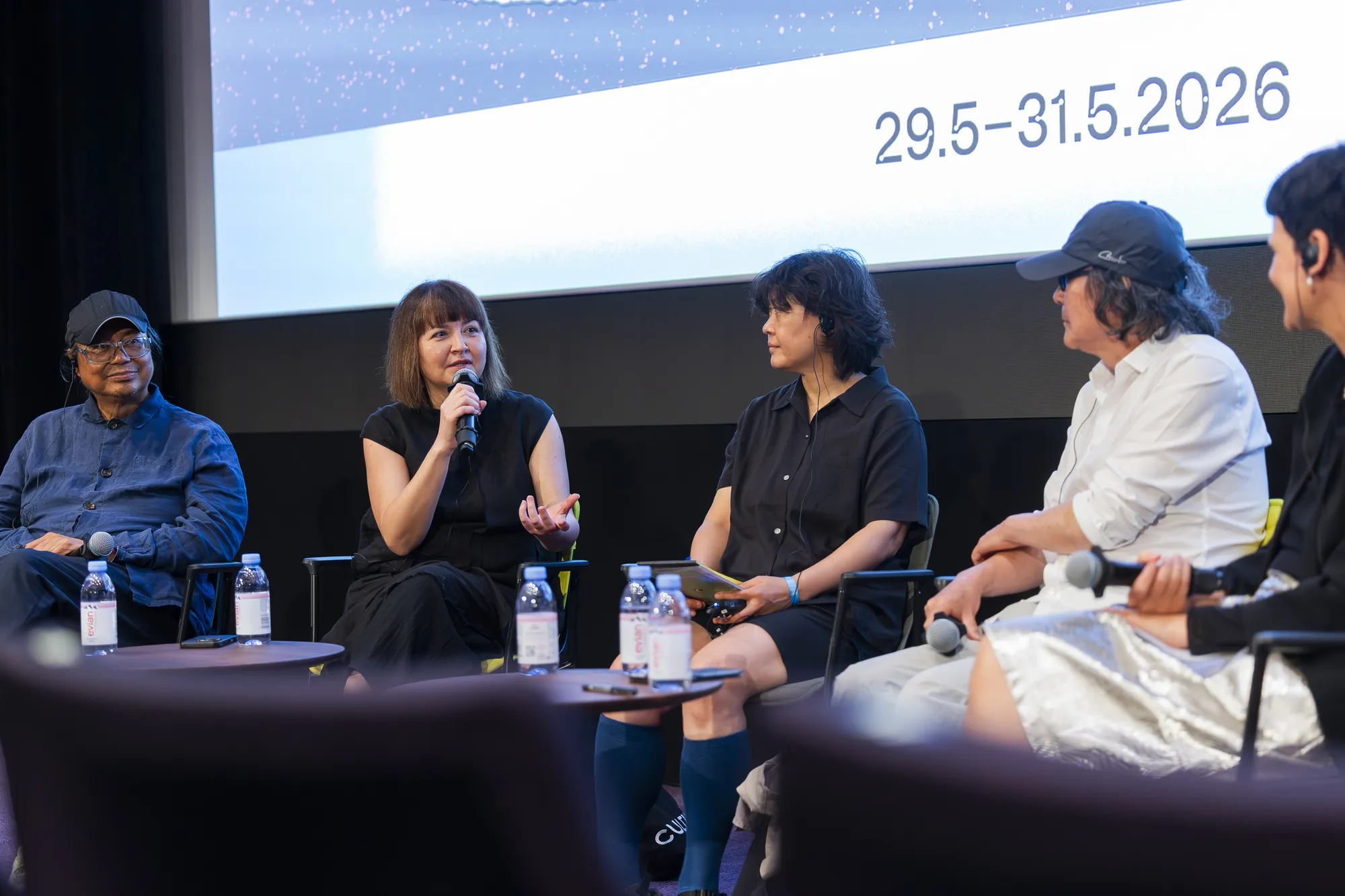
‘Space Enter Shift: A Round-Table Discussion with Jieun Cho, Larissa Sansour, Rirkrit Tiravanija, and Xu Bing’, 2026. Photo: Jeff Cheng Tsz Fung, M+, Hong Kong
Leah: The term ‘avant-garde’ is rooted in a specific historical context. Emerging from the art movements of the early nineteenth century, it came to signify practices that transcended medium boundaries, broke with tradition, rejected conventional modes of narration, and challenged established aesthetic values. The avant-garde works of that period represented a clear rupture with what had come before, both formally and conceptually, and could therefore be considered genuinely avant-garde. Yet the term is, in semantic terms, inherently time-bound and relational: it can only exist in relation to something being surpassed. Without an established norm, there can be nothing to advance from. The avant-garde has never been an isolated concept; it is defined through difference.
Myra: Looking back at this edition, the cinema programme alone comprised seventy-two works: thirty-nine spanning almost the entirety of the twentieth century, thirty-two produced after the turn of the millennium, and one bridging the two periods. This very arrangement blurred the boundary between the contemporary and the historical. When works from different eras are brought together within the same space, do the notions of ‘before’ and ‘after’ remain so clear-cut? Within the cultural context of 2026, what, exactly, are these works resisting—mainstream cinematic narratives or the film industry itself? If no clear object of opposition can be identified, does the avant-garde risk functioning merely as a label?
Catherine: That's a good question. Tiravanija associates this phenomenon with nostalgia, and if he is referring to our contemporary tendency to revisit twentieth-century works, such nostalgia is not without cause. When what was once radical is absorbed into art history and becomes the norm in contemporary practice, it is almost inevitable for the avant-garde to be viewed through a retrospective lens. Nevertheless, each work articulates the avant-garde differently. For me, what felt most immediately avant-garde was the way it manifested through cinematography.
Myra: I have a similar feeling towards this. Take Takashi Ito's Distant Voices (2024), screened at this year's festival, as an example. Through a subtle disjunction between sound and image, the film evokes the sensation of its characters drifting through time and space. Here, the image is no longer merely a vehicle for narrative; it becomes an active agent in shaping perception.
During the post-screening conversation, Ito explained that he had asked his actors to perform with an almost expressionless restraint, deliberately minimising the psychological cues conveyed through facial expressions in order to produce a sense of mechanical detachment and emotional distance. This meticulous orchestration of performance, sound, and image allows the work to move beyond realist storytelling, generating estrangement and affect through form itself—an approach that embodies its avant-garde quality. Ito also cast performers with little or no acting experience, joking during the Q&A that he could have invited members of the audience to appear in the film. In a sense, this near deskilling in directing serves to foreground the actors' presence as figures situated within the film's carefully constructed interplay of image and sound.
Catherine: I also watched Ito's early works from 1985 to 1995, in which I saw his acute self-awareness in engaging the moving image as a medium in its own right. Rapid editing, stop-motion photography, and the recurring presence of photographs and cameras all foreground the image not simply as a device but as a means of prompting viewers to reflect on the nature of the medium itself. From Spacy (1981), his first short film made from a hand-drawn flipbook, to the trails of light recorded in Zone (1995), his practice consistently responds to technological developments. Yet this response is far from a passive acceptance of technological constraints or the aesthetics of a particular era. During the post-screening conversation, Ito explained that he continues to shoot on film for the sense of nostalgia it evokes, despite the ubiquity of digital technology. For him, technology is not bound to its era; rather, it is a creative language shaped through deliberate selection and choice.
Returning to Myra's point about Distant Voices, I see the film as an extension of Ito's longstanding exploration of form, one that expands into the realms of sound, performance, and the experience of time and space. But is formal experimentation alone enough to make a work avant-garde?
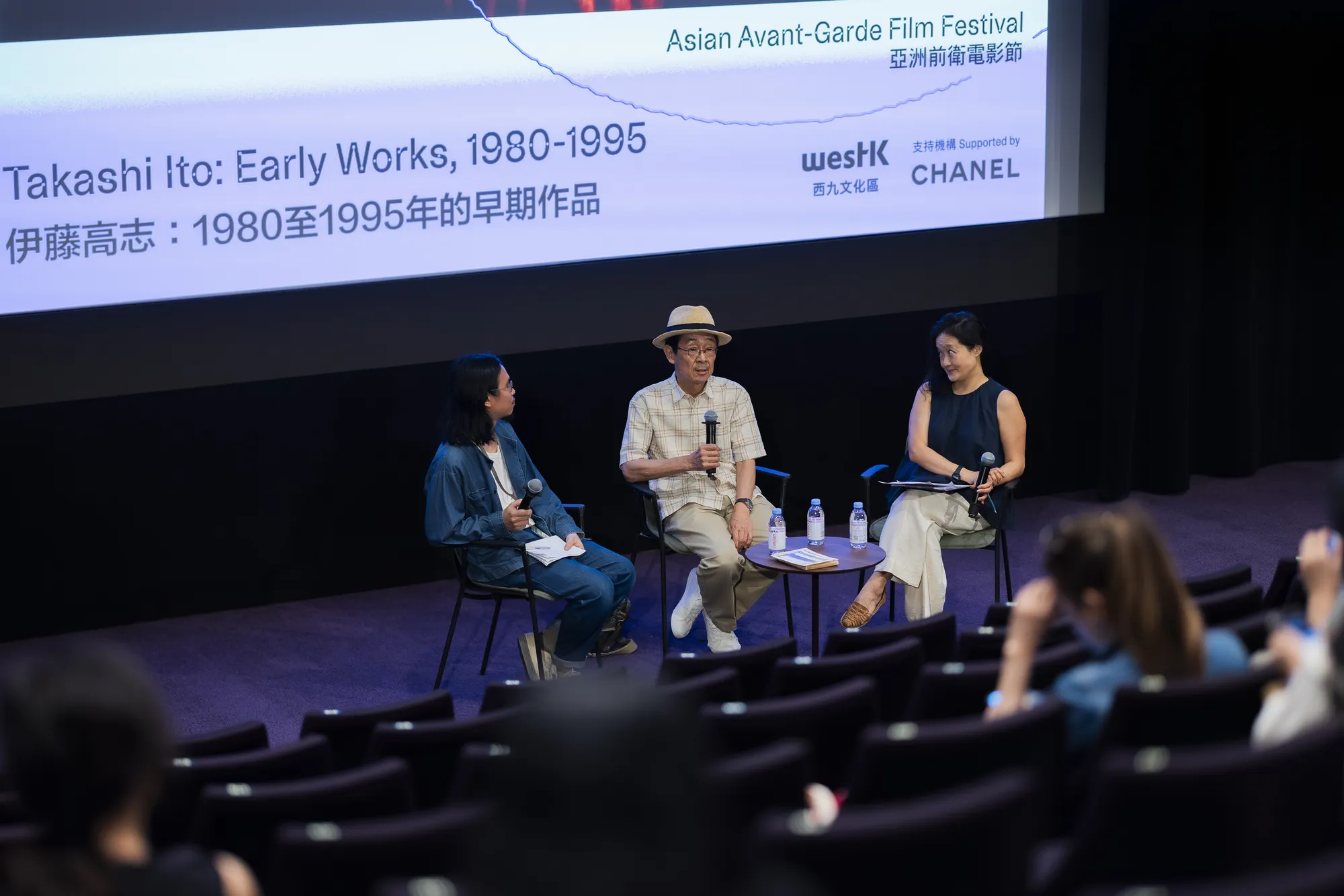
Post-screening talk of Takashi Ito, hosted by M+ Curator of Moving Image Chanel Kong. Photo: Jeff Cheng Tsz Fung, M+, Hong Kong
Leah: Form is undoubtedly an important mode of expression, but as Catherine pointed out earlier, visual techniques once considered innovative have since become reproducible conventions. New creative ideas therefore become another lens through which we can approach avant-garde films. Many works in this edition do not begin from a blank slate. Instead, they incorporate pre-existing images—fragments of older films, behind-the-scenes footage, archival recordings, and photographs—reorganising materials already in circulation. Rather than inventing an entirely new cinematic language, these works offer new ways of seeing through the careful selection, editing, and reinterpretation of existing images.
I was particularly reminded of Hao Jingban's Off Takes (2016), which opens with the assertion that there are no unusable segments, only those yet to be understood. By re-editing discarded footage of Beijing's social dance community and pairing it with voiceover narration, the film transforms what was once peripheral into the centre of its narrative, revealing stories beyond the finished film while illuminating a particular historical context in China. In this sense, the avant-garde arises not only from new technologies or unconventional materials but from the precision and originality of perspective.
Myra: This kind of reconstructive practice reminded me of Xu Bing's AI-generated film. This year's festival featured a blind-box screening in which audiences entered the cinema without knowing what they were about to see, only to encounter a work generated by AI from existing films as its source material. Xu didn’t shoot or edit the film, nor did he select the footage to construct its narrative. Much of the creative process was delegated to AI.
Before the screening, Xu remarked that AI has watched more films than any of us could in a lifetime. The work fundamentally challenged our assumptions about both filmmaking and spectatorship. It even made us question whether it could be considered a film at all. As the screening began, many audience members quietly walked out, while Xu remained standing alone at the back of the cinema, observing everything. I couldn't help but wonder whether the audience's response had itself become part of the work.
Leah: That's an acute observation. In A Case Study of Transference (1993 and 2018), Xu presented two pigs mating before a live audience, provoking profound discomfort among those present. As he remarked during the roundtable discussion, the audience has always been ‘the generative force that sustains the work’s ongoing formation’ and remains integral to the artistic space.
New technologies challenge not only the notion of auteur cinema but even the basic assumption that a film requires a director. Xu's AI-generated film demonstrates the audience’s response to new creative propositions, recapturing a key dimension of the avant-garde—its capacity to establish new artistic possibilities while remaining, in a sense, not for everyone. The blind-box screening thus functioned like a kind of mirror, reflecting both the audience's curiosity towards the unknown and their deeper bewilderment and resistance to AI.
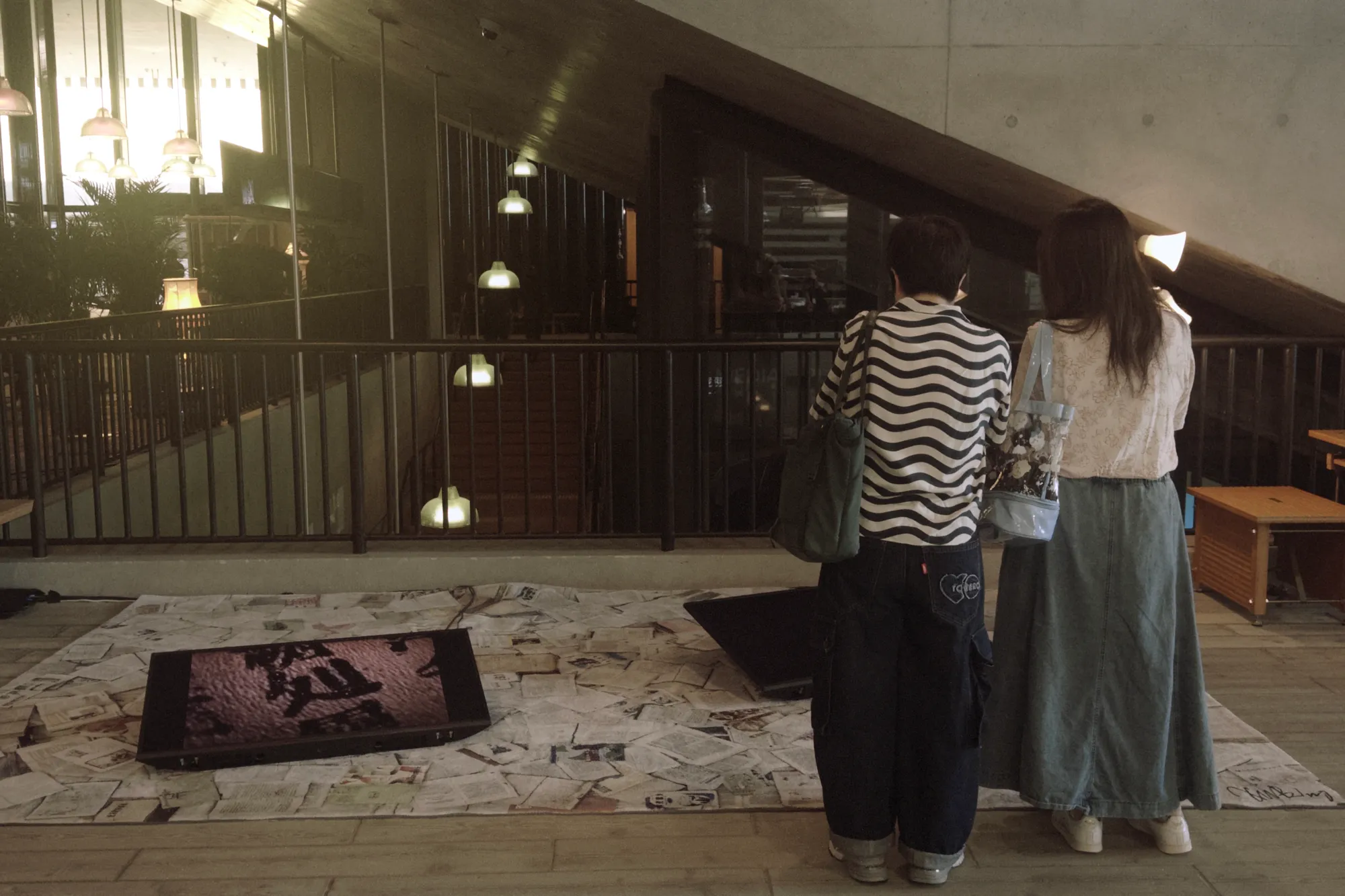
Installation view of A Case Study of Transference (1993 and 2018) by Xu Bing at AAGFF, 2026. © Xu Bing. Photo: Leah Li
Catherine: At the same time, this collage-like mode of editing, assembled from fragments of existing films, reminded me of Linda Chiu-han Lai’s Door Games Window Frames: Near Drama (2012). Drawing from eleven Cantonese thrillers and melodramas from the 1960s, Lai isolates recurring scenes and visual compositions, reorganising them into a new cinematic experience. The key difference between Lai's and Xu's works lies in the mode of construction: the former is meticulously structured through human intention, whereas the latter is deliberately assembled by AI in an unruly, almost schizophrenic manner. Xu seems to push beyond the limits of human authorship, using the latest AI technologies to explore artistic possibilities that exceed human capacities.
As Gilles Deleuze argues in Cinema 1: The Movement-Image, the history of cinematic narration underwent a decisive shift. Classical cinema relies on direct causal relationships between events, while postwar filmmakers increasingly sought to dissolve those connections. Today, that rupture seems to have expanded into an even wider experimental terrain—one unfolding between AI and human creativity, bringing us back to the same fundamental question: how do audiences make sense of image sequences that are fragmented and circuitous?
Every era has its avant-garde, just as every era has its critics. Perhaps this generational scepticism and the recurring resistance towards emerging media are themselves a form of the avant-garde.
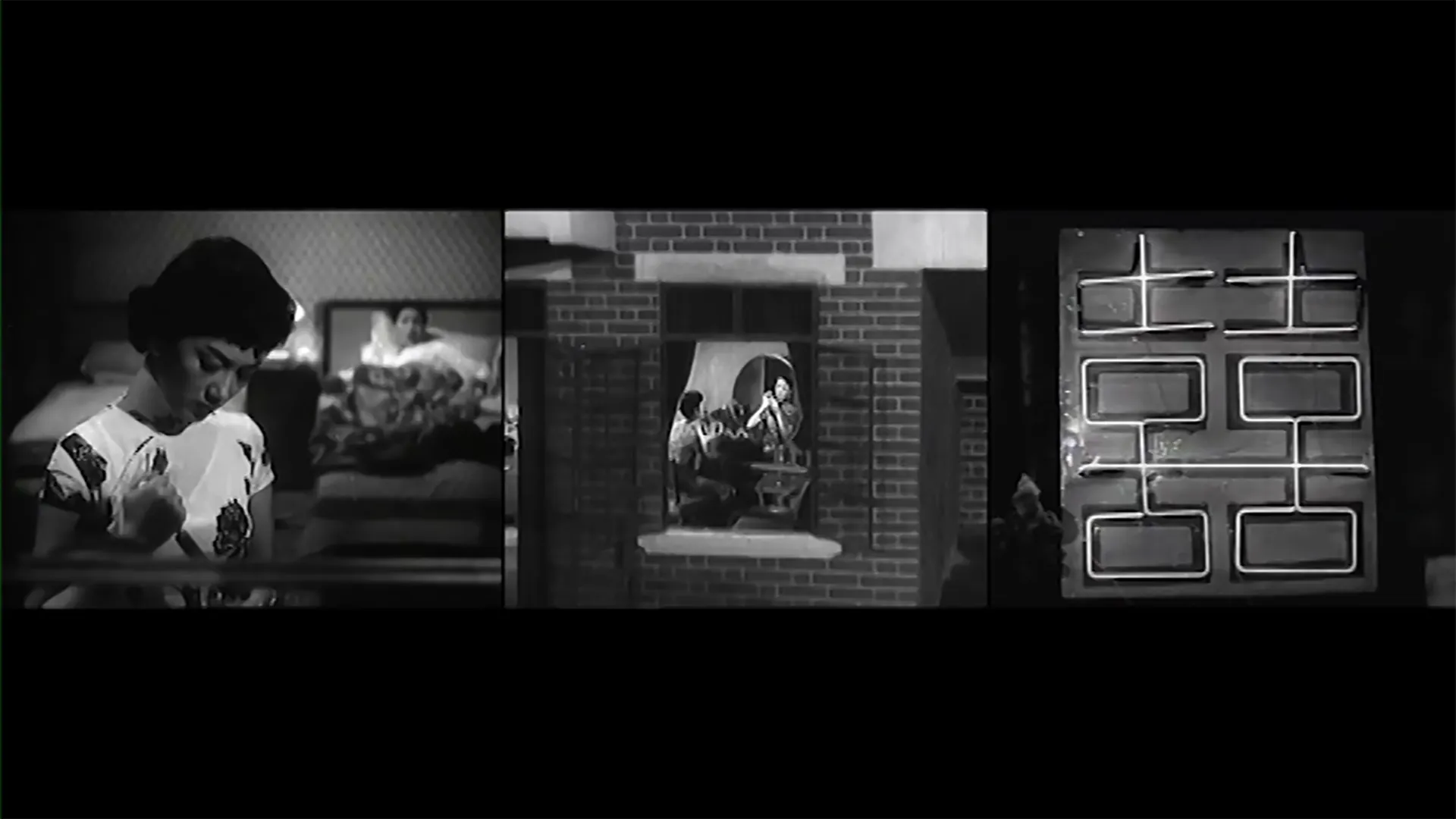
Linda Chiu-han Lai. Door Games Window Frames: Near Drama, 2012. M+, Hong Kong. Gift of Linda Chiu-han Lai, 2019. © Linda Chiu-han Lai
Myra: Throughout this discussion, we've tried to define the avant-garde, only to realise that it resembles a Venn diagram. At its centre lie the familiar frameworks of cinema: established narrative structures, psychological characterisation, the film industry, and commercial distribution—conventions that shape our habits of viewing. Beyond that circle, however, there is no equally coherent form. These works share neither a unified style nor a common method: some foreground formal experimentation; others reorganise historical footage; still others relinquish authorship to AI. They may differ radically from one another, yet all remain resistant to existing frameworks. For that reason, the avant-garde is less a style than a relative position. Without an established framework, there can be no possibility of being ‘avant-garde’.
This article is adapted from conversations among this year's student editors during the Festival. Over the course of three days, M+ granted us the opportunity to move between screenings—observing, discussing, and recording what we encountered through writing.
Catherine Ip is a year-two student at The University of Hong Kong, double majoring in Comparative Literature and Art History.
Leah Li is a year-two student at The University of Hong Kong, double majoring in Comparative Literature and Economics.
Myra Tse is a graduating student at The University of Hong Kong, double majoring in Comparative Literature and Ecology & Biodiversity.