
Festival Lounge Art Installations: The Flux of Participation
2026-06-09
Four art installations can be found in the public areas inside and outside the 2026 Festival Lounge. Upon entering the venue, visitors immediately have to make the same choice: how they wish to participate. The four works explore the boundary between viewing and participation through themes of interpersonal relationships, the documentation of animal performance, physical immersion, and the sharing of communal memories.
Outside the cinema’s main entrance, Rirkrit Tiravanija has placed two ping-pong tables, extending a light-hearted invitation that almost feels incidental. The paddles and balls rest on the tables, while the work title, untitled 2026 (honey in rocks water in stones), is printed on the tabletops. The title’s phrase evokes the image of softness overcoming hardness. A pioneer of relational aesthetics, Tiravanija has created works in formats such as cooking pad thai on site and setting up makeshift kitchens, using them to explore diasporic experiences, cultural differences, and interpersonal mediation. He does not tell people what to do; he simply sets the scene and waits for people to engage. Whether or not they are film festival attendees, people often pick up the paddles with a smile, giving the work a sense of ease and playfulness.
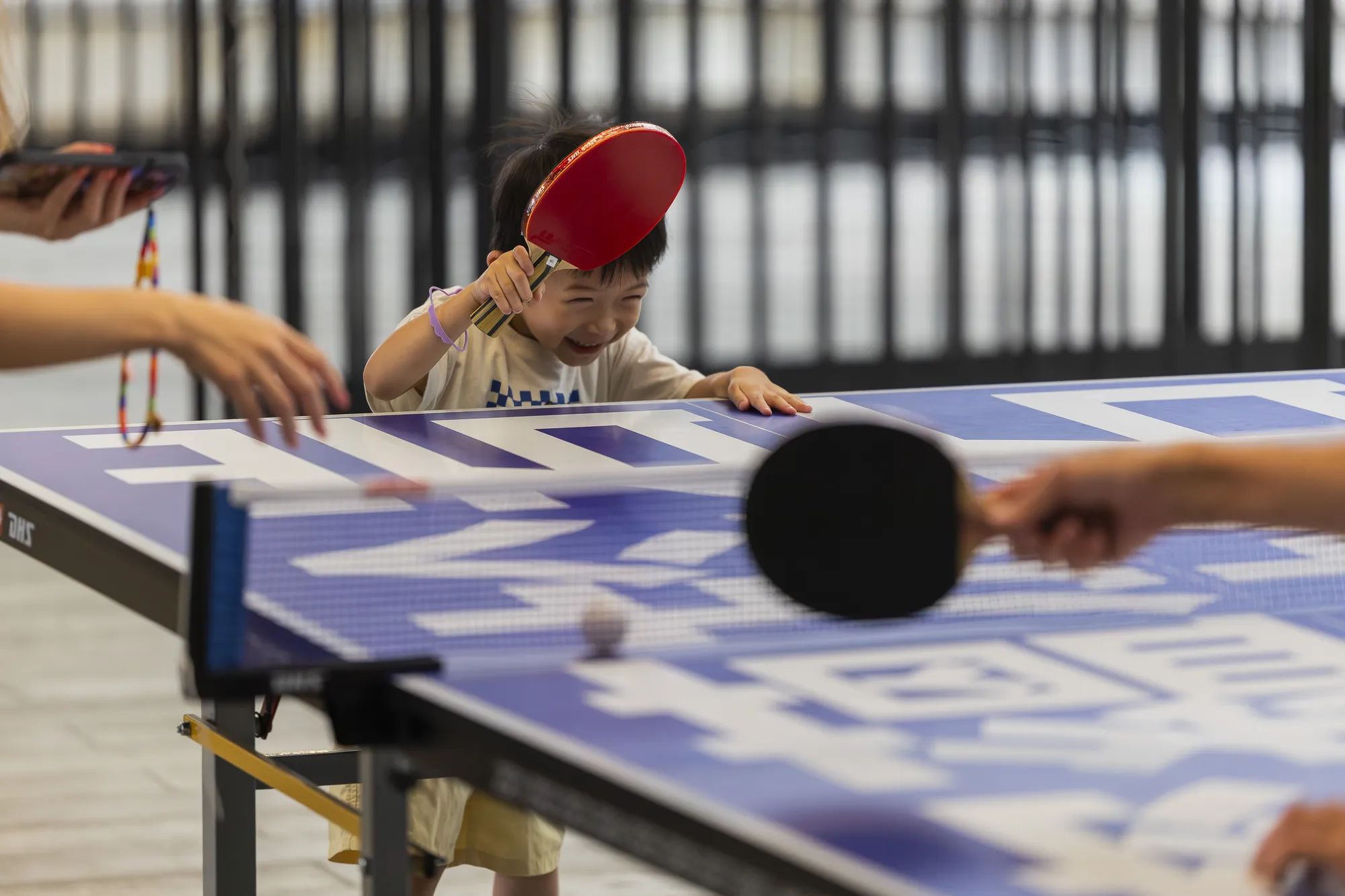
Rirkrit Tiravanija, untitled 2026 (honey in rocks, water in stones), 2026. © Rirkrit Tiravanija. Photo: Jeff Cheng Tsz Fung, M+, Hong Kong
Walking straight in through the main entrance, one encounters Xu Bing’s A Case Study of Transference, which offers another form of unavoidable participation: the gaze and the self-awareness that arises from it. The exhibition space is covered with a carpet printed with an image of books in various languages, while two screens above it show footage from 1993 and 2018, documenting the preparation and performance of the project’s two enactments. Xu carefully selected two pigs, a male and a female, from a farm. On one hand, he trained the boar to mount a wooden frame to facilitate copulation; on the other, he chose a sow in heat. In the 1993 version, he inscribed pseudo-English letters all over the boar and pseudo-Chinese characters on the sow. The 2018 version replaced them with his self-invented ‘Square Word Calligraphy’. The two pigs were then brought into the exhibition space to copulate under the watchful eyes of the audience. The work offers little explanation, aside from a single subtitle: ‘The audience watches the two pigs’ behaviour but thinks about human matters.’ Xu had no way of knowing whether the pigs would mate as intended; yet amid the audience's whispers, embarrassment, and varied reactions—both on- and off-screen—the two pigs remained utterly oblivious and indifferent to their human onlookers.
What the audience is looking at are the pseudo-scripts on the pigs' bodies—a hybrid and conflicting tangle of Chinese and Western civilisations, tattooed onto moving flesh. At the same time, they confront the taboos they harbour towards the animality within themselves. Here lies the core of the ‘transference’ in A Case Study of Transference: civilisation imposes a set of symbols on the animals, and through the act of gazing, the audience discovers their difference from the animal, thereby recognising the artificial nature of civilisation itself.
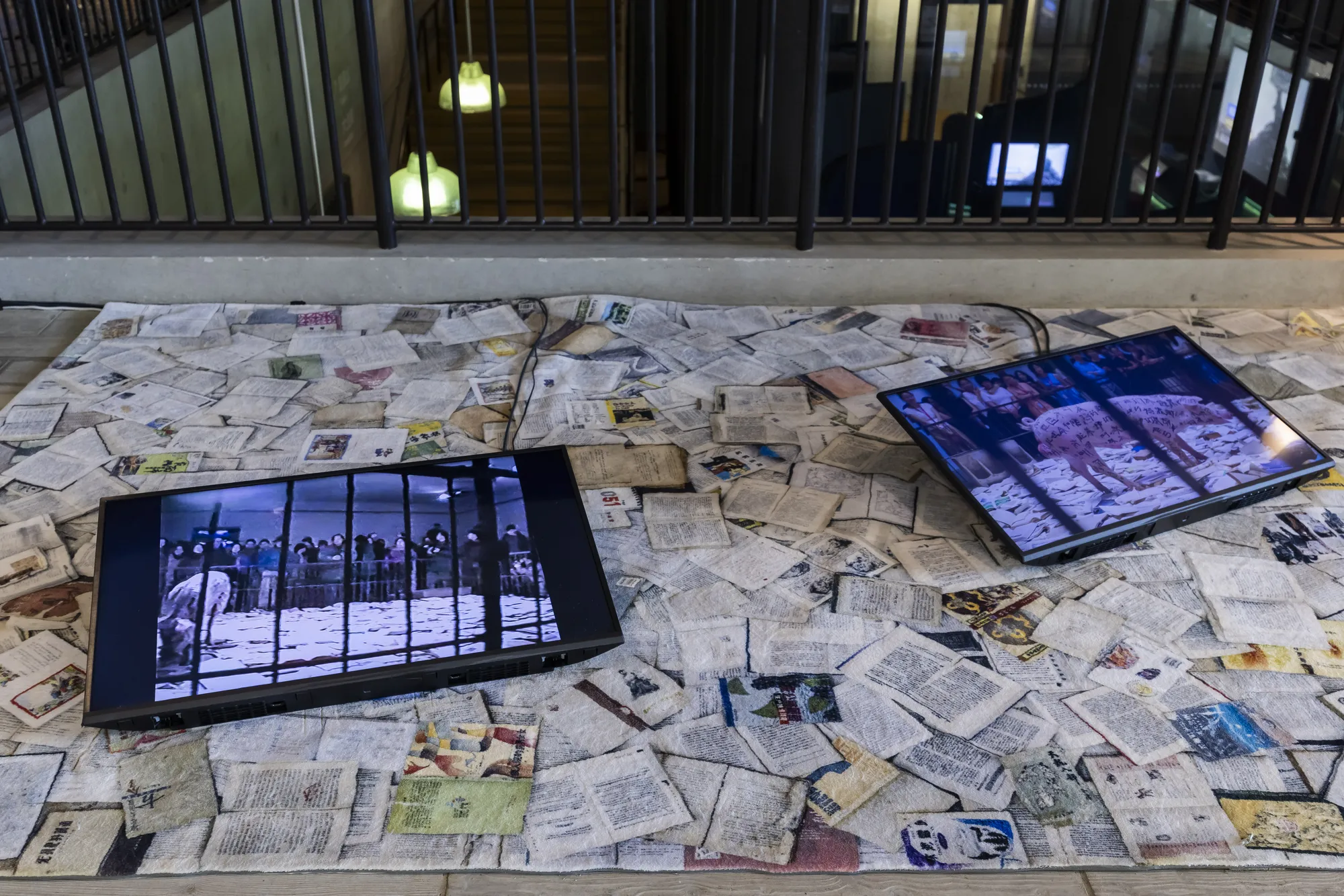
Installation view of A Case Study of Transference (1993 and 2018) by Xu Bing at AAGFF, 2026. © Xu Bing. Photo: Jeff Cheng Tsz Fung, M+, Hong Kong
Zheng Mahler’s What is it like to be a (virtual) bat? Phase IV – Bat Meditation consists of only a few VR headsets, headphones, and two swivel chairs, allowing the audience to briefly experience a bat’s senses. The work uses field-recorded sounds and point cloud data to reconstruct the landscape of Mui Wo, Lantau Island, and draws on the visualisation meditation practices of Tibetan Buddhist Deity Yoga. Guided by mystical music and whispers, participants are led to gradually transform from a human into a local Japanese house bat (Pipistrellus abrahmus), soaring across the island alongside the bat colony. To convey the experience of perceiving space through sound waves, the work’s overall visuals are blurred, the colours vivid and alien, and the flight trajectory turbulent, inducing waves of vertigo.
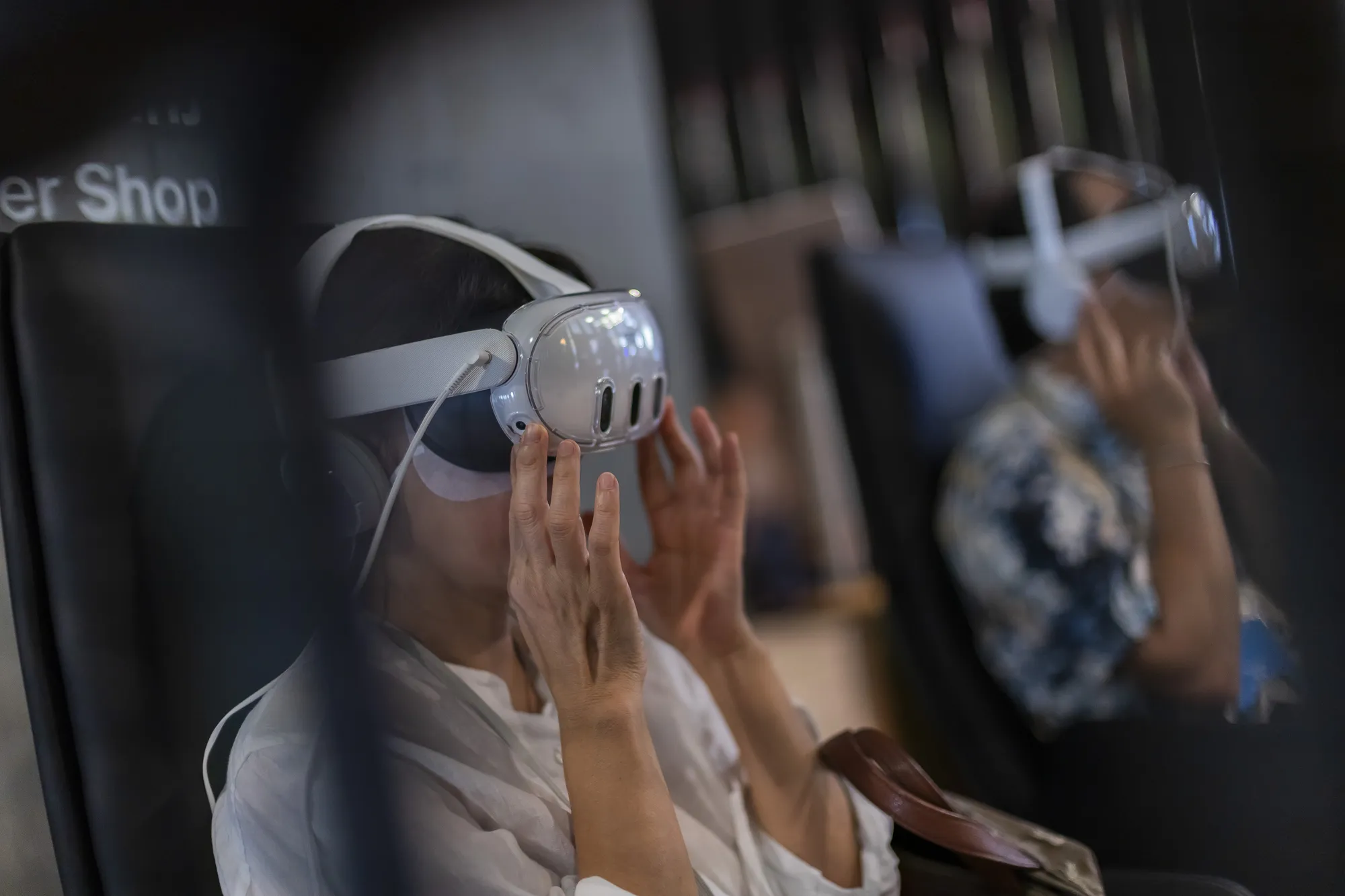
Visitors experiencing What is it like to be a (virtual) bat? Phase VI – Bat Meditation (2022–2023) by Zheng Mahler at AAGFF, 2026. Photo: Jeff Cheng Tsz Fung, M+, Hong Kong
Participants experience a genuinely non-human sensory world firsthand. In a sense, it offers another expression of Zhuangzi’s butterfly dream—yet instead of unconsciously becoming a butterfly in sleep, we consciously re-participate in the surrounding world from the perspective of another species. Of course, the work does not aim to present standard bat perception, but rather uses technological means to expand the boundaries of conventional cognition, subverting the singularity of human physiology and mentality.
Who Forgot the Village by South Korean visual research band ikkibawiKrrr lacks the sensory shock of the other installations. Accompanied by gentle music, the audience sits on a carpet and watches video clips across five screens from a lower, more concealed vantage point. During the Festival, this installation has naturally evolved into a public space for resting, chatting, and participating in activities, transforming it into a small ‘settlement’ of its own.
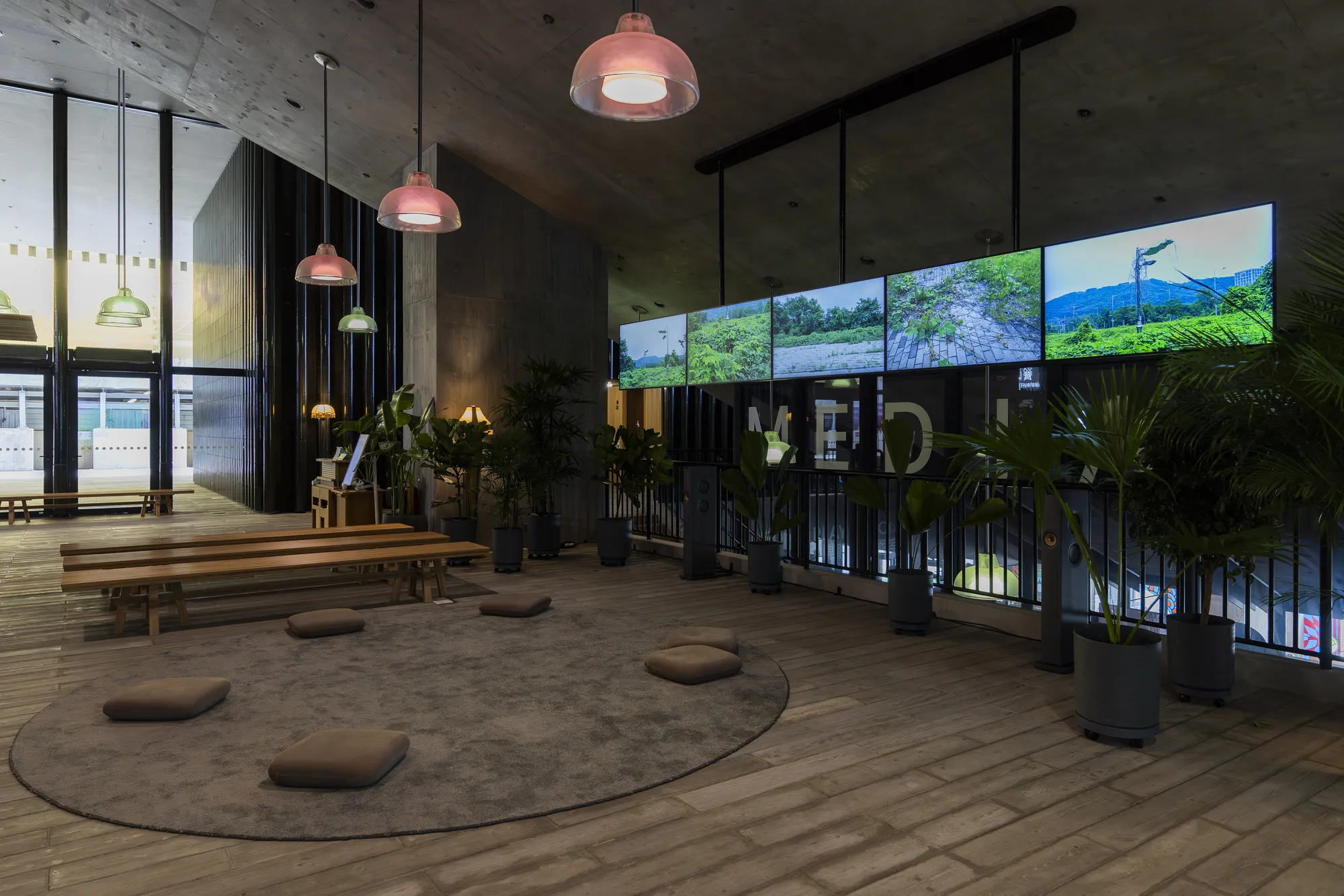
ikkibawiKrrr, Who Forgot the Village, 2026. © ikkibawiKrrr. Photo: Jeff Cheng Tsz Fung, M+, Hong Kong
In the band's name, ‘ikkibawi’ means ‘moss–rock’ in Korean, while ‘Krrr’ mimics the sound of a rock rolling. Moss has no roots and grows close to the ground. The collective's artistic approach, too, mirrors this very imagery. Their concern lies precisely with the fragile, vanishing marginal spaces under the pressure of capitalism and modernity.
For this project, the members immersed themselves in village life, extending their practice beyond art, echoing the way moss gradually spreads from hidden recesses. The footage was taken in villages in South Korea, as well as Korean settlements in Japan and China, all of which are dwindling due to labour migration and large-scale construction. The images capture everyday scenes: tricycles, vegetable fields, a peeling propaganda mural on making rice cakes, pickled vegetables, and more. These ordinary objects and traces of life quietly evoke a shared nostalgic melancholy, a sense of community connection, and a certain kind of collective memory.
These four installations showcase a plurality of media and evolving artistic approaches, presenting multiple possibilities of participation. Brought together for the Festival, these installations are connected like a series of opened windows, inviting audiences to step into the rich landscape of contemporary Asian art.