
Excerpt from ‘Who Forgot the Village’
2026-06-02
Jieun Cho (ikkibawiKrrr)
Editor’s note: Jieun Cho of visual research band ikkibawiKrrr reflects on the process of conceiving Who Forgot the Village, a video installation inspired by the disappearance of villages and an effort to find ways of remembering them. The work was originally commissioned for the Manifesto of Spring exhibition at the National Asian Culture Center in Gwangju, South Korea, where it took the form of a reimagined madang (village square) and doubled as a site for gathering. For AAGFF 2026, ikkibawiKrrr has adapted the work for the Festival Lounge, bringing its communal spirit to Hong Kong.
This is an excerpt from an essay in the Manifesto of Spring exhibition catalogue, edited by Yunjung Shim and published by the National Asian Culture Center in March 2026.
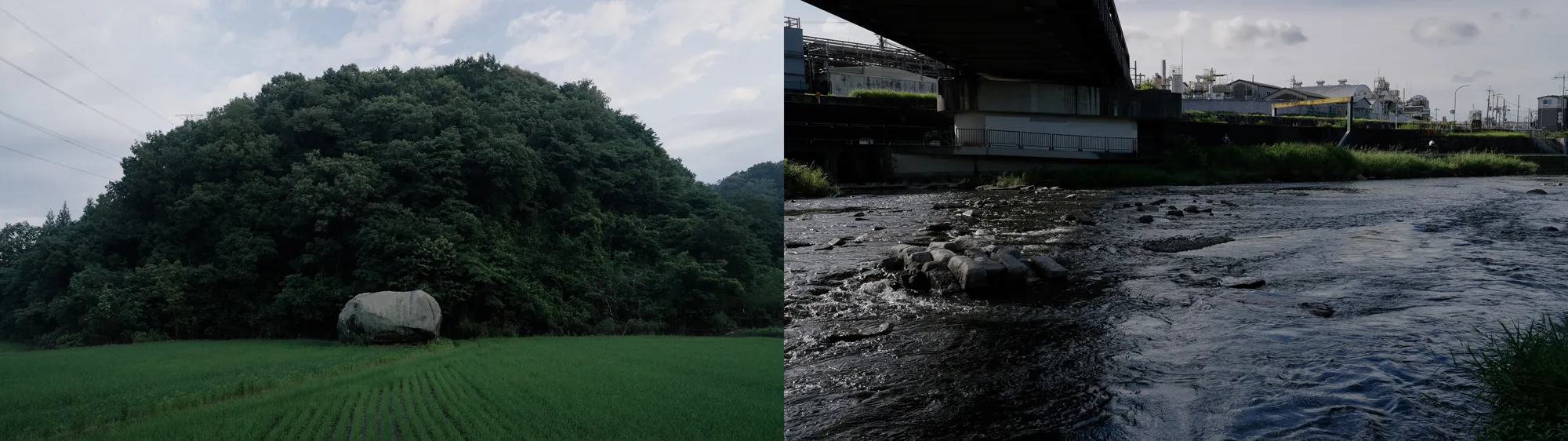
ikkibawiKrrr, still from Who Forgot the Village, 2025, two-channel video, 4K, sound, 12 min. Commissioned by National Asian Culture Center in collaboration with M+ Hong Kong and Aranya Art Center. Courtesy of the artists.
I try to think of what we call a village. A place where people gather to live, an old place, many houses clustered together, a place of familiar neighbours—its scope and meaning feel elusive. And what about community? A village is supposed to have one. The dictionary defines it as an organic society shaped by essential ties: blood, place, and friendship. But in life, that too remains uncertain. Each of us carries a different village in mind. Each of us imagines a different kind of community.

ikkibawiKrrr, still from Who Forgot the Village, 2026, five-channel video, 4K, sound, 9 min 27 sec. Courtesy of the artists.
As we worked on our project, we visited many villages. Quiet villages. Emptied villages. Vanished villages. Villages as they are now. Each one had something distinct, but rather than laying out every story in detail, we chose to think of the village in a more universal sense. We looked at villages from the position of an observer. So I returned to places I had visited ten years ago and stepped into others for the first time.
We filmed in Ikuno, Osaka, a place once known as Ikaino. It was hard to say exactly where Ikaino began and ended, but we kept circling the market area where Zainichi Koreans (ethnic Koreans in Japan) gathered. I first encountered this place in Seok-il Yang’s novel Risking the Night. [1] It was a place where Koreans survived by secretly collecting and selling war scrap near Osaka Castle. The dense Korean settlement described in the novel is no longer visible. Still, the village appears vividly in the poems of Sijong Kim.[2] The two writers are said to have briefly worked together in their youth, collecting scrap metal side by side.[3] Some villages shift and change, taking on new meanings through history. Time and again, we encounter villages that no longer reveal themselves in the present landscape. In a market in Osaka, in the scene of kimchi and salted seafood for sale, I sense a persistent, familiar affection.
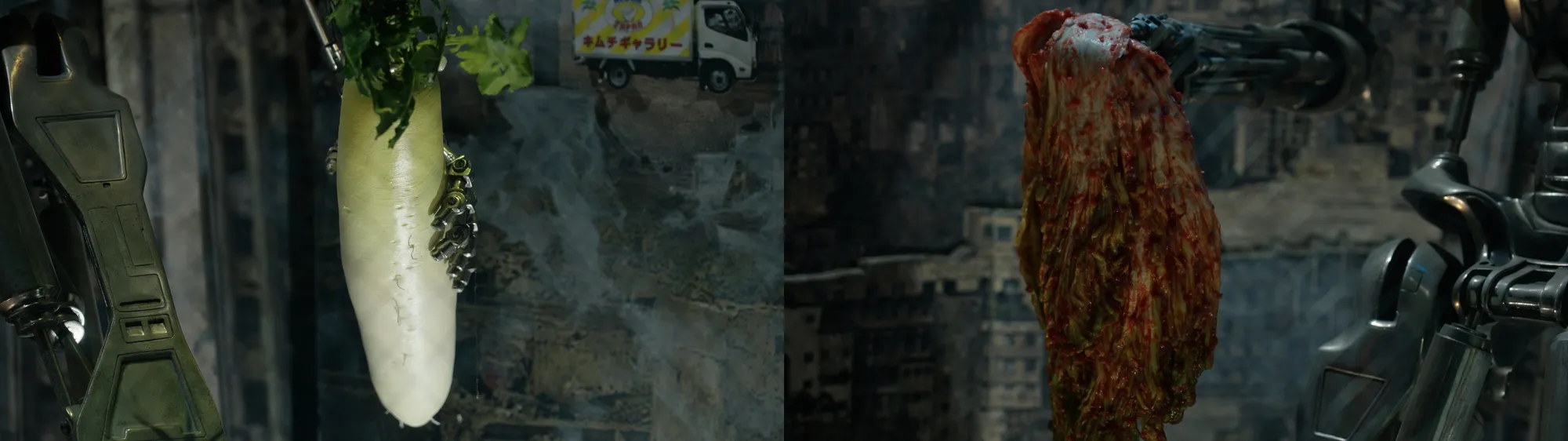
ikkibawiKrrr, still from Who Forgot the Village, 2025, two-channel video, 4K, sound, 12 min. Commissioned by National Asian Culture Center in collaboration with M+ Hong Kong and Aranya Art Center. Courtesy of the artists.
And what about villages in Yanbian? In Yanbian, an autonomous region for Korean Chinese, it is easy to come across Korean villages. In each one, there are murals of people in hanbok (traditional Korean dress), playing the janggu drum. Behind the village hall, the janggu and buk drums sit as if forgotten. In hard times, people pooled money to build Korean schools and sent their children there. Now the schools have closed. An old woman told us her children live in South Korea. Some still dry fermented soybean bricks in the sun. Across village after village, people continue with their own daily lives. Yet, villages in China, Korea, and Japan all seem to share something. Their vitality belongs to the past. The present feels quiet, as if nothing is happening. That bustling time, when people gathered to make rice cakes and sing together, has already slipped into memory.
Scenes in the video include people from Geumgang Village in Yeongju, Gyeongsangbuk-do Province. In 2016, the construction of the Yeongju Dam forced them to relocate as a group. We planned to visit the former village with them and film at its entrance. But heavy rain fell the day before the shoot. The dam swelled, and the road into the village was blocked. We couldn’t enter. Instead, we filmed with Geumgang Village in the distance, across the water. Today, the village is submerged and can no longer be seen. But in the video, the villagers—and the village far behind them—remain as they were. The same is true of the villages of Hasong, Yongsori, and Ipseok, which also appear in the work. These places were flooded long ago by dam construction. Now, only a village marker stone remains, placed in a park near the dam. It once marked the village. Today, it looks almost like a memorial for what has disappeared.
We made the video by moving between quiet villages that hold many stories and the scenes of city people who gather for their own purposes. Who Forgot the Village (2025) is shaped by a series of questions: What kind of village are we looking at? What kind of village do we remember? Why do villages disappear? What do villages believe in? How can a village be imagined? How are the villages that remain protected? How do a village’s stories endure? When did the village become something outside of us? Where can we settle? The work was made within these questions. Some say that ‘a village is a ruin of the future’. With a faint awareness that what we try to protect will one day disappear in the distant future, we nevertheless reflect on what we have already lost—things we relinquished ourselves, even before they were gone.
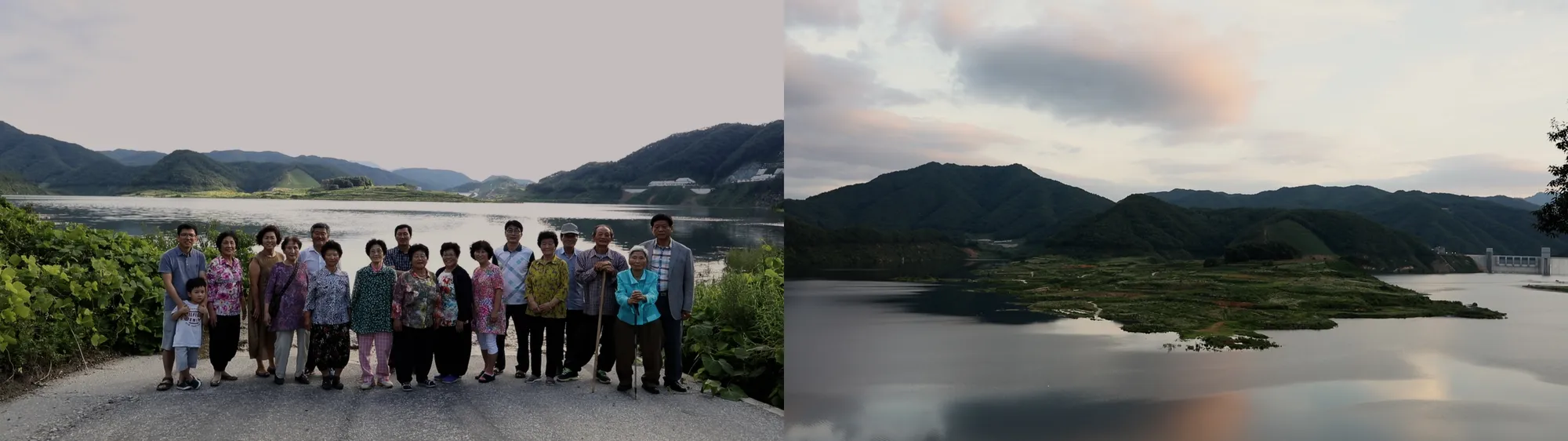
ikkibawiKrrr, still from Who Forgot the Village, 2025, two-channel video, 4K, sound, 12 min. Commissioned by National Asian Culture Center in collaboration with M+ Hong Kong and Aranya Art Center. Courtesy of the artists.
For my generation in Korea, ritual often felt heavy. It was a world where my own self could not fully appear—patriarchal, conservative, and authoritative. It felt burdensome, even painful. But for my child, ritual seems to mean something else. In a nuclear-family society, my child longs for people. When everyone gathers on the day of an ancestral rite, it brings real happiness. It is something to wait for, something to feel excited about. I begin to think again about the everyday rituals around a village: year-end gatherings, the first full moon of the lunar year, small festivals, family memorial rites, and birthday celebrations. Even when their meaning is simple, the rituals that connect my mother, myself, and my child bring time and continuity into view.
While working on Who Forgot the Village, I often thought of the people we met around the same time at Hashinoshita Center.[4] Through the ritual of the festival, they generate and circulate their stories. Being with them, we fell into those stories. Then we added other stories to them, and set out again, travelling toward more villages. We grieve for villages, and we miss them, and we ask how shared memory and experience might be practiced in everyday life. Sharing rituals and holding public memory and experience together is also a narrative act. Stories move, continue, change, and become new. A village where time can remain is a place of stories. Ritual helps those stories stay alive in time. A village with living stories expands a better world.[5] We wait for such villages.
[1] ‘One theory holds that the place-name Ikaino (猪飼野) came to be used for the area in Ikuno where Zainichi Koreans were concentrated because Korean labourers who worked on the Hirano River improvement project settled nearby and raised pigs. In other words, a Zainichi Korean community formed in a place that Japanese people avoided.’ Yang Seok-il, Bameul geolgo [Risking the Night] (Goyang: Taedong Publishing, 2001), 16.
[2] ‘[…]
Here and there, something spills over,
and if it does not spill over, it withers away.
A Korean neighbourhood that loves to treat others.
Once it begins,
it lasts three days and three nights.
A neighbourhood loud with the clang of gongs
and the beat of drums.
Even now, shamans lose themselves and dance,
a neighbourhood of vivid, primary colours.
Wide open,
and as generous as it is,
it scatters sorrow as if it were nothing.
Seeping in clearly, even to eyes that see in the dark,
invisible to those we cannot meet,
a Korean neighbourhood
in faraway Japan . . .’ Kim Sijong, ‘The Invisible Neighbourhood’ (1978), excerpt.
[3] In 2015, I was fortunate enough to interview the novelist Seok-il Yang. At the time, I was researching ‘modern Asian migrants who went to the Pacific’, and Yang’s novels were also an important resource.
[4] Hashinoshita Center is a community led by musician Aesu Kim (Yoshiki Kim) and Takemai. Together, they create festivals and share Asian music with others. A project collaborated with them was exhibited at the Aichi Triennale under the title O, Open the Door, I Pray
[5] Jeongheon Kim, ‘Kim Jeongheon Column: Good Stories Expand a Better World’, Hankyoreh, October 18, 2018.