Larissa Sansour and Søren Lind: Sculpting Memories, Redirecting Narratives
2026-06-02
Larissa Sansour and Søren Lind continually sculpt Sansour’s personal memories, family history, and Palestinian pathos into films. In this year’s AAGFF, In Vitro (2019) and Familiar Phantoms (2023) were screened in succession, while their most recent film, A Sunken Tale of Losses Delayed (2026), had its Asia premiere. Each work brings forth a different landscape that disrupts our linear understanding of time and space, inviting us into their interpretation of the Palestinian psyche. While they are distinct works, these three films resonate as if they share the same universe, offering different responses to memories, identity, and nostalgia.
Sansour began her artistic journey as a painter and sculptor. Upon witnessing the siege of Bethlehem in 2002, she took on documentary filmmaking out of an urgency to record Palestinian experiences. Initially a producer and scriptwriter in Sansour’s early projects, Lind has since become her collaborator at work and spouse in life. While their narrative interest in Palestinian heritage stems from Sansour’s personal background, the two of them conceptualise the final presentation, with Lind focusing on scriptwriting and Sansour on visualisation. Together, the duo creates films that interweave archival footage, introspective conversations, and symbolic visuals to safeguard Palestinian heritage against cultural erasure.
Søren Lind, Larissa Sansour. In Vitro, 2019. Photo: Courtesy of the artists.
In Vitro is set in a post-apocalyptic world, in which all traces of Bethlehem’s previous civilisations have been wiped out by a flood of black oil, creating a clean slate for reflecting on the meaning of memory. Survivors move into a geo-bunker beneath the ruined city, where weeds have started to regrow and the water system is being rebuilt. With the aid of technology, the environment seems to recover from the aftermath of the calamity, but can its people cope with this disruption?
The film is structured around the argumentative exchange between Dunia, a dying woman who survived the eco-apocalypse, and Alia, a clone designed to preserve Palestinian memories and heritage. Despite their different backgrounds, the two of them debate over the value of memories. While Alia at times questions her identity and belonging to this city, Dunia reminds her—and the viewers—that memories might be abstract and unreliable like myths, but it is their presence, not their absence, that propels one toward a better place. This nuanced conversation highlights the complexity of memories, a recurrent theme in the duo’s films.
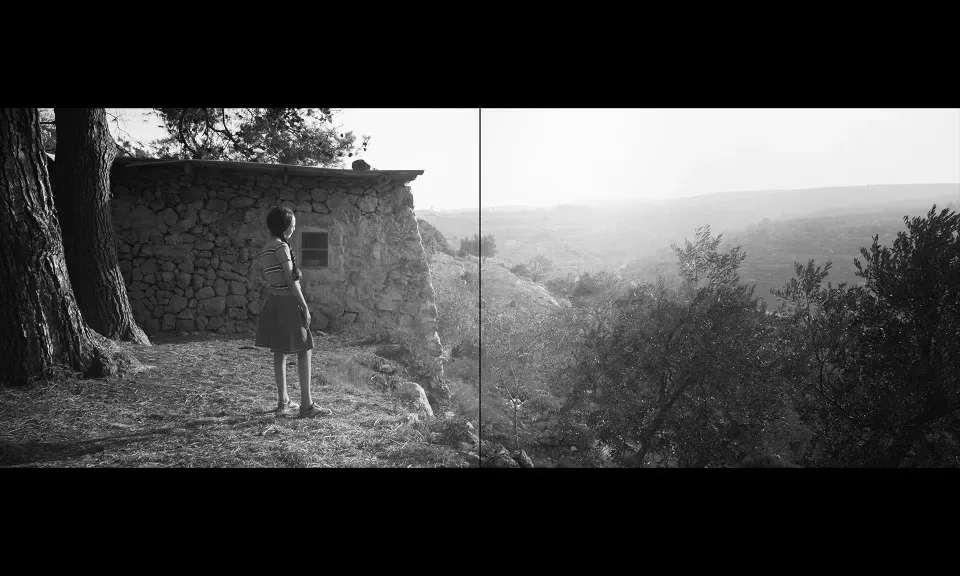
Sansour narrates her own childhood and adolescence memories in Familiar Phantoms, focusing particularly on what she remembers and what she has fictionalised. By intertwining the film with family archival footage and childhood photographs, she reveals the unreliable nature of memories and the space it holds for imagination. For example, she recalls burning political pamphlets in the toilet—a memory she long held as proof of her participation in her father’s resistance against the Jordanians. But that memory was in fact her sister’s. This memory is dear to Sansour, perhaps not because she experienced it, but because it mirrors her own sentiments towards a repressive political environment.
Søren Lind, Larissa Sansour. A Sunken Tale of Losses Delayed, 2026. Photo: Courtesy of the artists.
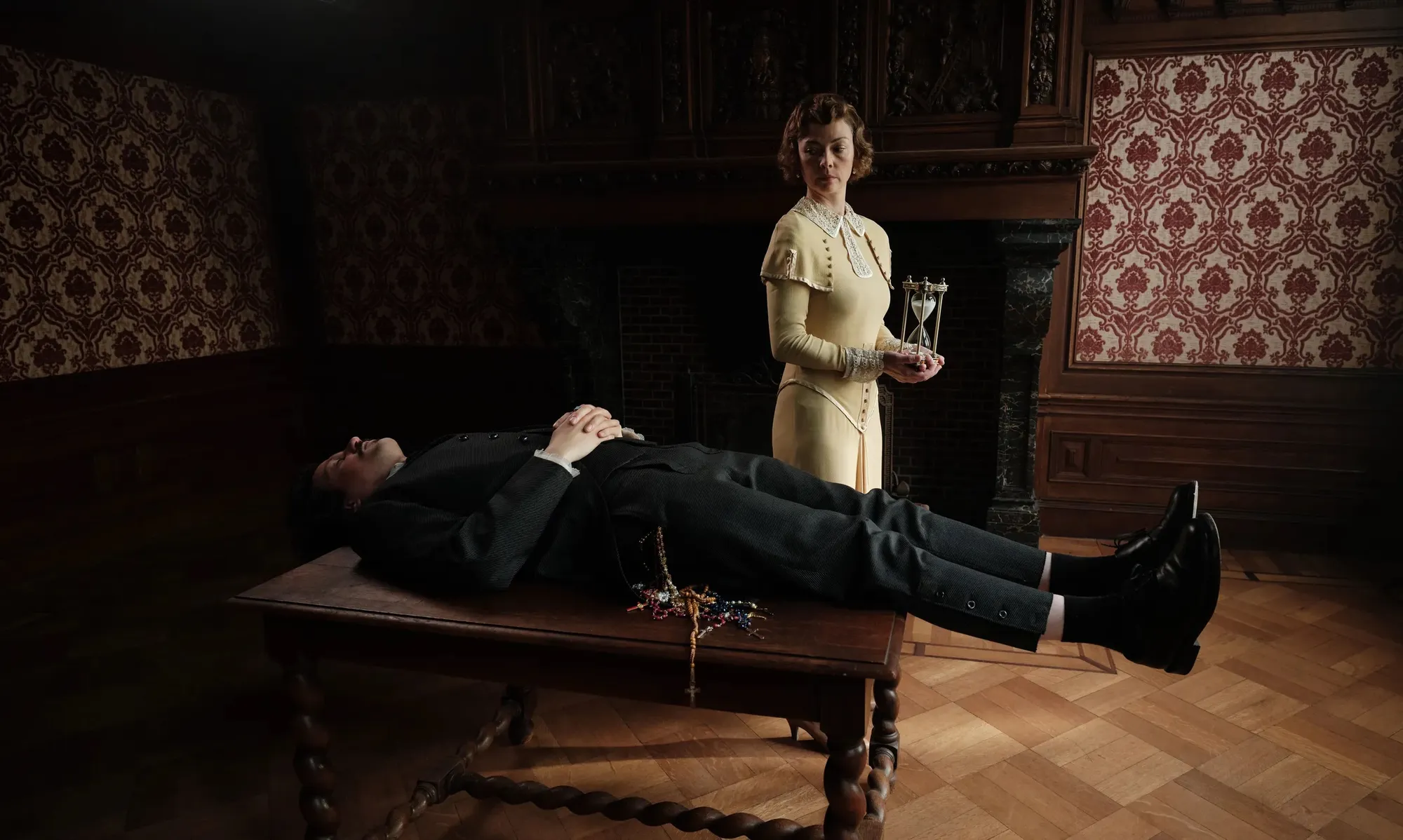
In A Sunken Tale of Losses Delayed, the exploration of memories takes place on a pirate ship that exists beyond time and space. Through the lens of a merchant bound for the 1900 Paris World Fair—the last passenger to board the vessel—we discover the pirate captain’s collection of colonial artefacts, looted with the intention of one day returning them to their owners and retelling their stories.
Unlike the personal and familial recollections in Familiar Phantoms, this film maps of memories, as told by characters from different historical periods. Clinging to physical objects from their pasts, these passengers repeat again and again about their treasured memories, including a lady who speaks of her niece’s wedding as she sews a dress and a man who reminisces about his wife while holding a matching wooden box. In some way, the passengers themselves are also vessels of memories, much like the colonial artefacts the captain tries to rescue. Perhaps the film is an attempt to ‘pirate’, restore, and alter seemingly immutable histories, reclaiming agency from reductive established narratives by piecing together scattered memories.
These three films selected all hold vital memories for Sansour, her family, and the broader Palestinian narrative, responding directly to specific contexts and landscapes. In Vitro’s underground bunker provides a safe space for the nurturing of ideas, while Familiar Phantoms brings us to the soil of Palestine with Sansour’s family history. Finally, A Sunken Tale of Losses Delayed leaves the grounded security of land entirely for the unpredictable ocean. During a post-screening talk at the AAGFF, Sansour and Lind noted their unconscious repetition of motifs and characters across their films. In these works, this motif of memories spirals from one film to the next, underscoring how crucial personal memories are to identity—regardless of how fallible, fictional, and mythical they may be.