
‘Tracking Nomadism’ and Expanded Cinema at AAGFF
2026-05-29
Annessa Chan
Take a closer look at what lies between the auditory and the visual, and you may find a space of infinite possibilities. In Tracking Nomadism, commissioned especially for AAGFF 2026, Emirati photographer Lamya Gargash and Singaporean composer, sound artist, and musician Vivian Wang come together for the first time to present an expanded cinema experience. By casting a cinematic lens on Gargash’s photography and pairing it with Wang’s sonic response, their collaboration invites new discoveries and unexpected connections for both artists and audiences alike.
Wang moves fluidly across the arts, science, and technology and is no stranger to M+, having previously been commissioned for the ongoing Shanshui: Echoes and Signals exhibition. Although she was a founding member of The Observatory, a Singaporean experimental rock group established in 2001, her practice has since expanded over the past two decades into sound art and beyond, incorporating non-traditional elements such as environmental sounds and field recordings into durational works for live performances, expanded media, and interactive installations. A noise and improv musician, Wang cites Balinese gamelan and Southeast Asian microtonal systems as important inspirations for her creative practice. Many of her works are site-specific and draw on subjects ranging from human gestures (The Way We Move, The Way We Sound, 2023) to traditional agricultural methods (Priests & Programmers 'Regeneration', 2019), transforming source materials as unconventional as rice or wind through post-production processing. In 2018, Wang moved to Switzerland, where she now teaches composition at the Zurich University of the Arts.
Meanwhile, Lamya Gargash mainly works with photography, though she has also experimented with other mediums such as film and installation. She grew up in Dubai in the 1980s and 1990s, a period of rapid modernisation marked by the development of major ports and free economic zones, before leaving to study abroad in London in the mid-2000s. Starting in 2006, she became interested in preserving the architectural spaces of her childhood as they began to deteriorate. This interest evolved into her thesis project, the Presence series (2006–2007), which documents abandoned or soon-to-be-abandoned homes in the United Arab Emirates. Since then, the types of spaces she photographs have expanded to include hotels, zoos, cinemas, and even museums such as the National Portrait Gallery in London. Her subjects range from inhabited places to those in various stages of abandonment, but people are notably absent, encouraging viewers to notice the details of the spaces themselves. Even so, the traces and remnants of human presence in these ‘empty’ spaces are unmissable, evoking warmth, nostalgia, and even anxiety.
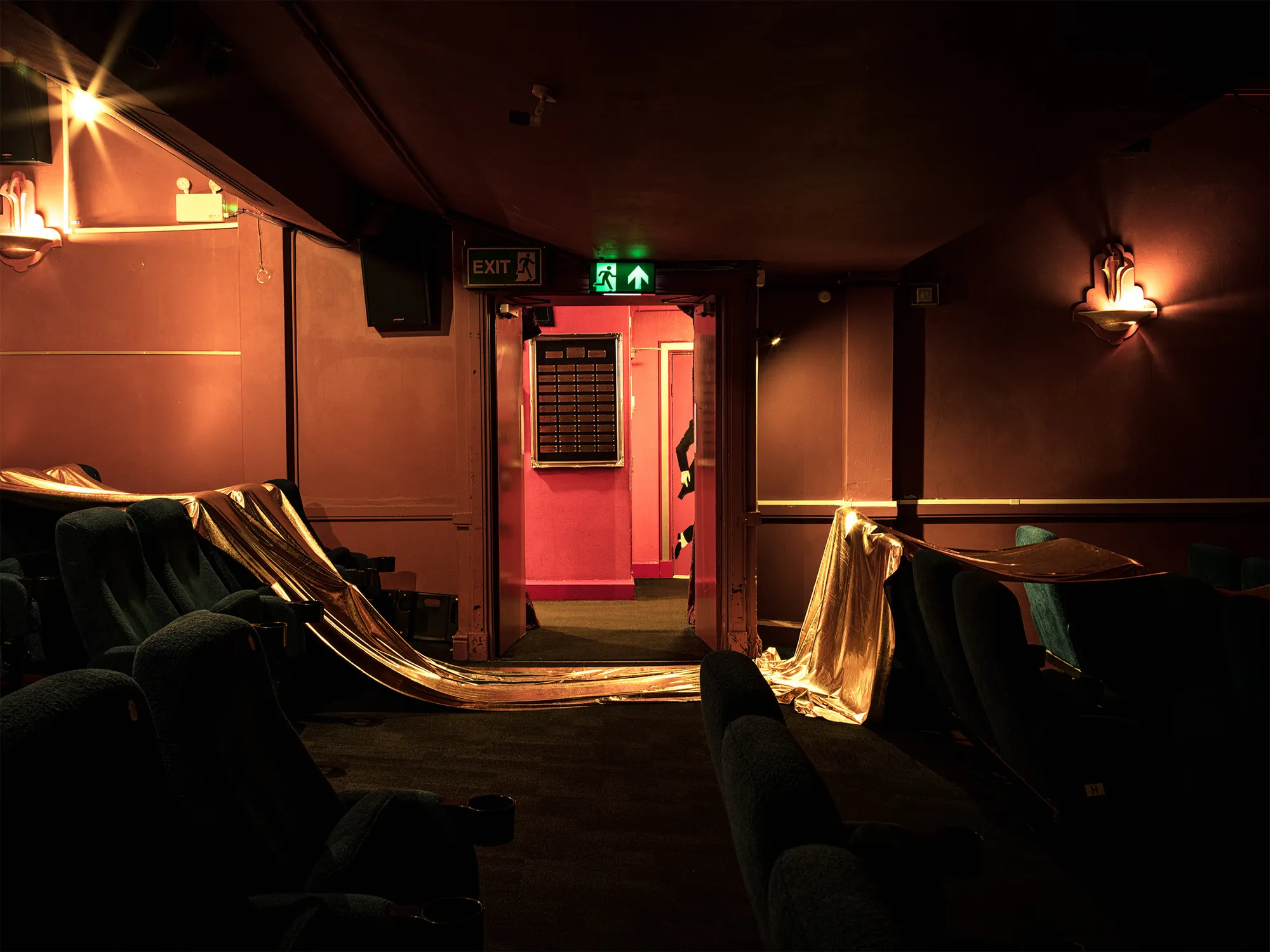
Lamya Gargash. The Little Theatre. Bath, UK, from the KUN series (2024). By kind permission of Bath. Photo: Courtesy of the artist and The Third Line, Dubai.
Both Wang’s and Gargash’s practices engage with space to explore the social, cultural, and psychological dimensions of humanity. Like many sound artists, Wang is concerned with how sound exists and resonates within a space. For example, Drawn to Light (2024), her commissioned piece for M+, detects light levels and motion inside the gallery and generates corresponding sounds using prerecorded tones from singing bowls, providing a unique experience for each visitor. Gargash’s photographic practice is less interactive, aiming instead to capture the ambience of a space. Viewers can notice and examine the traces that people leave behind, such as how certain interior design choices characterise the function of a space or what the personal belongings suggest about their owners’ tastes. An early body of her work, the Familial series, was first presented at the Venice Biennale in 2009 and showcases the interiors of one-star hotels in Dubai, revealing their similarities and differences. The discreet inclusion of the artist’s personal family portraits in these photographs adds a further layer of intimacy. More recently, her KUN series draws inspiration from her life experiences in Sharjah, Dubai, Abu Dhabi, and Bath. Scenes from these seemingly disparate cities are connected through a draping golden fabric that appears throughout the series.
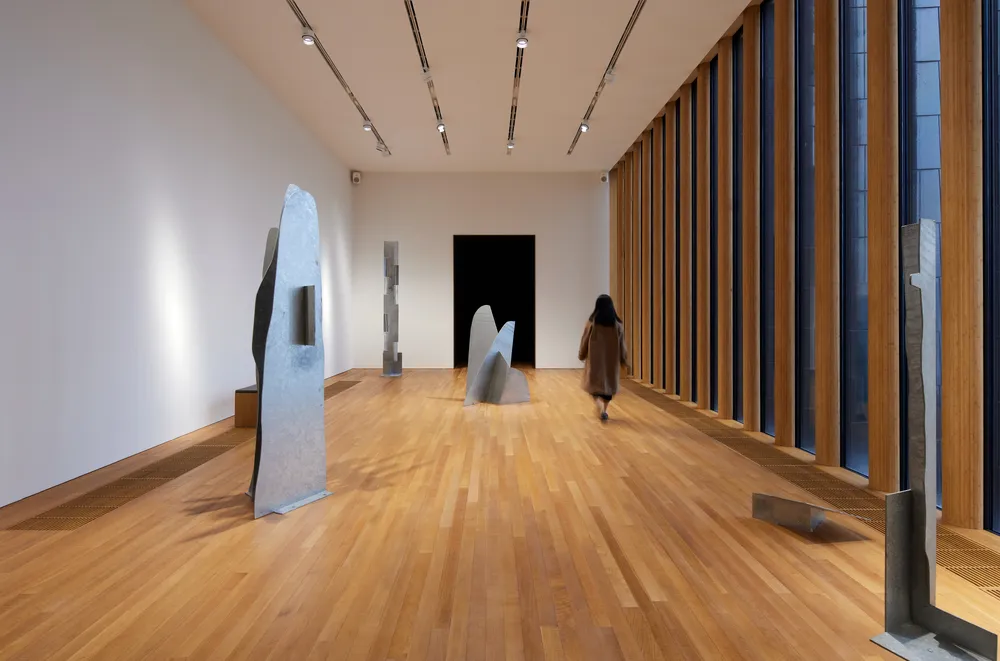
Vivian Wang’s Drawn to Light (2024) is presented alongside sculptures by Isamu Noguchi in Shanshui: Echoes and Signals, 2024. M+, Hong Kong. © The Isamu Noguchi Foundation and Garden Museum, New York / ARS. Photo: Dan Leung, M+, Hong Kong
Given their current geographic distance—Gargash in Dubai and Wang in Zurich—much of their collaboration so far has taken place online in the lead-up to the performance. For this piece, Gargash’s video editor Benjamin Looi has arranged two decades of her photography work in a new sequence, while Wang will join the performance in person with her musical equipment, bringing brand-new compositions written to complement and respond to the visuals on screen. The upcoming performance will also be full of firsts—Gargash’s photography being shown in a time-based media format and Wang performing her film scores live. Although Gargash will not be joining the M+ performance, recordings of her voice will be mixed into Wang’s sound.
But what is the significance of expanded cinema, and why has each edition of the AAGFF so far included live cinema events? For Silke Schmickl, CHANEL Senior Curator of Moving Image at M+ and head of the AAGFF curatorial team, such programming is integral to a festival looking at the avant-garde. ‘Whatever artists invent to challenge the classical black box of a traditional cinema is of interest to us,’ she says. Expanded cinema moves beyond the stereotypical cinema experience by presenting works in different formats and often incorporating a live performance element. By providing alternative ways of viewing, it allows audiences to become more deeply immersed rather than remain passive spectators. The curatorial team has been pairing visual artists with sound artists who have never worked together before to spark further interdisciplinary exchange, such as with Wang and Gargash this year; Ho Tzu-Nyen and Wong Hin-yan last year; and Wing Shya, nnscya, and Samson Sing Wun Wong in the first edition. Through this unique platform for experimentation, artists can continue to push their practice further, and audiences can encounter their work from a fresh perspective, opening up new ways of engaging with moving image.
Annessa Chan is Curatorial Assistant at M+.
Thumbnail for article: Portrait of Lamya Gargash. Photo: Courtesy of the artist; Portrait of Vivian Wang. Photo: Courtesy of the artist