
The $2 Aesthetic
2026-05-26
Roger Garcia
Editor’s note: In this essay, Roger Garcia discusses the importance for filmmakers to understand the conditions of their production. By juxtaposing auteurist and non-professional modes of filmmaking, he positions Super 8 as a format of independent cinema that demands a particular sensitivity to the medium’s inherent limitations and aesthetic qualities.
This text was first published in the festival programme of the 1981 Hong Kong Independent Short Film Exhibition, jointly presented by the Urban Council and Phoenix Cine Club. The original publication was bilingual, with the Chinese translation of the essay by Li Cheuk-to. The text was later reprinted in the first bulletin of Modern Films Production in spring 1985. The following is based on the 1985 version and has been edited for republication.
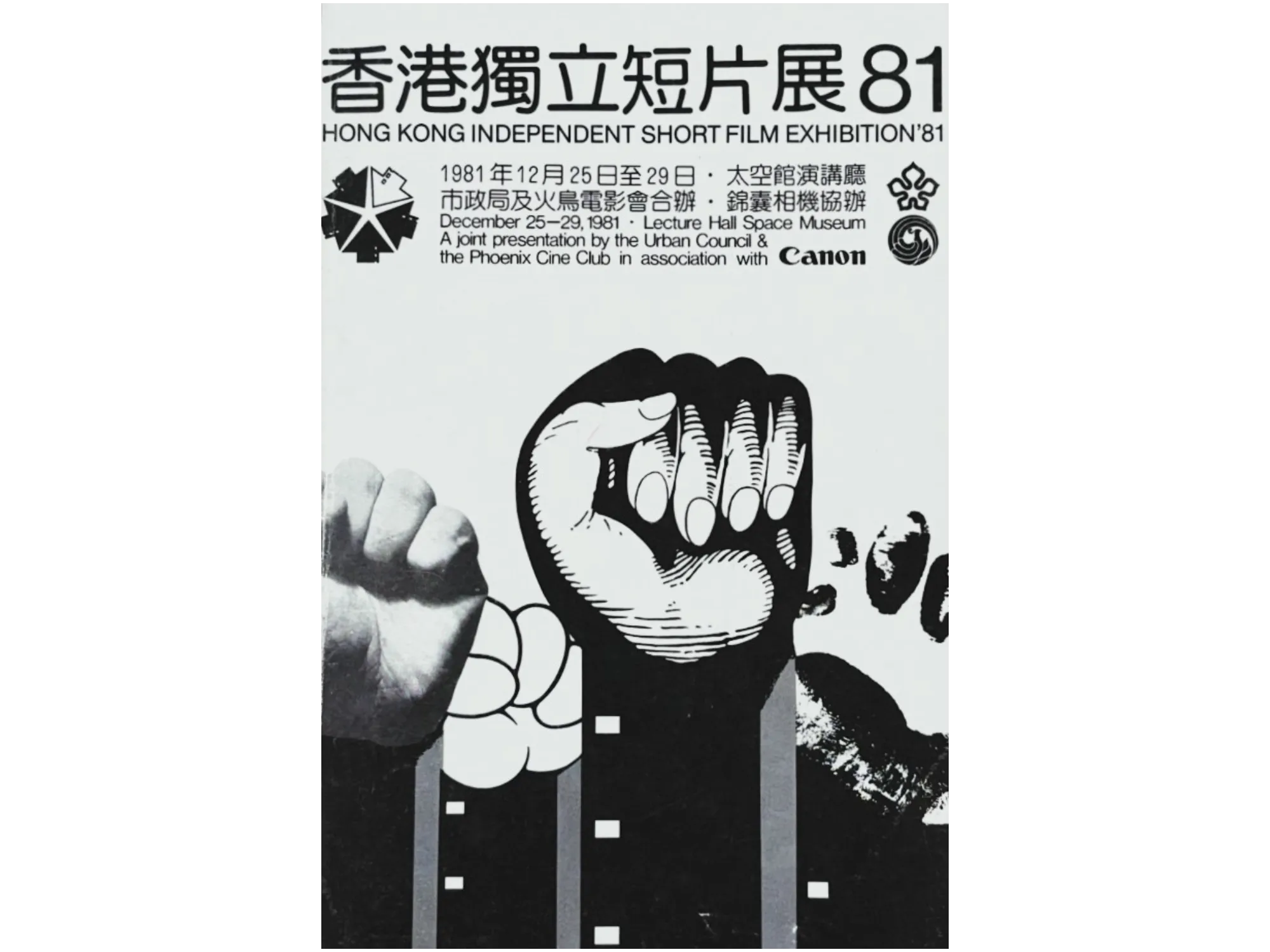
Phoenix Cine Club. Programme, Hong Kong Independent Short Film Exhibition, presented by the Urban Council and Phoenix Cine Club, 1981, offset lithograph, sheet: 21 × 13.9 cm. M+, Hong Kong. Gift of the Phoenix Cine Club, 2022. [CA65/5/18]. © The Government of the HKSAR, Phoenix Cine Club. Photo: M+, Hong Kong
The difference between a good and bad film is the amount of understanding each one displays. It's not important that a film has stars, or a story, or world-wide distribution. But it is essential for a film to show that its maker understands his or her subject, objective, style, audience, and conditions of production. I believe the latter is the most important, but least understood skill for any filmmaker.
What then, are these ‘conditions of production’? They are the limitations of the filmmaker and situations he or she works in. This is a simple answer to a complex problem. For example, it is not unusual to hear of the filmmaker whose debut film is a great success—his or her next film in a completely different genre, is a failure. The filmmaker has imagined that an ability in one genre can produce the same results in another. This is an illusion and rests on a misunderstanding of creativity in the cinema. In fact, cinema is different from other art forms because its creativity is not measured by invention (making new subjects) but by reinvention (making new angles on old subjects). Many filmmakers, usually the worst ones, refuse to admit the reality of their limitations. Those who do are the best. Eisenstein understood that the limitations of his cinema were the Russian Revolution and montage. Jean Renoir realised that he was basically making the same film throughout his career, because he had one thing to say—love is a material force which is constantly repressed by the spirit. Jean-Luc Godard understands that the limitations of his cinema are the elements of the medium itself, images and sounds. Jean-Pierre Gorin, Godard's sometime collaborator, put it best: ‘if you have $2, you make a $2 movie.’
Conditions of production extend therefore from the filmmaker's personality to the economic system. These conditions are not easily understood. The filmmaker must work at it, asking questions, thinking logically, and making the right decisions. This is not a theoretical process. It does not need to be formulated on paper, nor carried out consciously at all times. Some of the best filmmakers, such as Dziga Vertov (Man with the Movie Camera) and Alfred Hitchcock (North by Northwest), go through this process on film.
Non-professional, independent filmmakers are almost uniquely placed to articulate their conditions of production. They work at their own pace, within budgets determined by their other jobs, and often with material they know well. Outside the commercial/industrial system, they are able to make their own ‘micro-systems’ which do not require large sums of money thereby realising, on modest capital, the possibility of making more films later. Working in Super 8 adds a further dimension to this because it has its own aesthetic. There are limitations to the definition and grain of the Super 8 image: the range of film stocks is limited, and editing single system sound is not easy. But these are only limitations when compared with larger gauges like 35 mm or 70 mm. If we don't make this comparison, then these aspects are not problems at all—they are conditions of production.
Many Super 8 filmmakers are trying to make commercial cinema or TV in the wrong medium. A Super 8 filmmaker who understands the difference between imitating commercial films and making Super 8 films begins to understand his or her conditions of production. In discovering the specific technical and artistic qualities of Super 8, we can examine the aesthetic premises of the commercial cinema.
Few films in this year's Experimental and Animation sections attempted to address the problems of their conditions of production. Some tried to achieve production values which were beyond their budgets. Many appeared to be experimenting with ideas and concepts which were not cinematic. These faults do not reflect on the motivation of the filmmakers, but they do show that much work needs to be done on understanding just exactly what are the conditions of production experienced by Hong Kong independent filmmakers.
There is much to be done. Super 8 is a particularly difficult medium to work in. Many people have used Super 8 cameras, but few have explored the limitations and possibilities of its practice. As yet, we lack a theory and aesthetic of the Super 8 Cinema. But with the annual intervention of the Phoenix Cine Club's festival, it is possible that we are moving slowly, but surely, towards our own micro-system of the cinema.
Selected works by the author are featured in the ‘Roger Garcia: Hong Kong Modern’ segment of the Asian Avant-Garde Film Festival 2026, including New Maps of the City Part One: Notes for Films (1981), originally shot on the Super 8 format.
About the translator: Li Cheuk-to is Curator at Large, Hong Kong Film and Media, at M+ and the Chair of the Board of Hong Kong Film Critics Society.